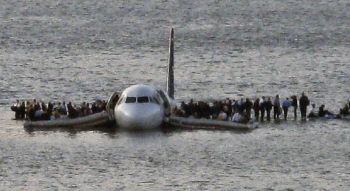
The hair-raising crash landing and rescue of flight 1549 has been all over the news the past couple of days. It is mind-boggling that no one was seriously injured.
As I processed the news I noticed something: the invocation of the "women and children first" rule, the notion that in dire circumstance, such as a boat sinking, women and children should be allowed to escape first. This idea goes back, in Anglo-American practice (there might be similar ideas in other cultures with distinct histories), to at least 1852 (ht Jezebel). As I heard it mentioned by people who had suffered through the crash, and by various commentators, it struck me as a Confucian idea.
That may sound odd to some, who associate Confucianism with a fairly rigid patriarchy that historically in China valued men over women and children. But Confucianism has always been more than crude patriarchy (even if it has been historically connected to patriarchy).
The core of Confucian thinking is Duty, living up to our obligations to family and society. The particular meaning of Duty emerges from specific social contexts: that which is considered an obligation will vary by time and by place. The idea of "women and children first" is generally understood and circulated in American society, even if it is unevenly practiced. Thus, to some degree, it was not surprising that it should emerge as an organizing principle for getting people off of the downed plane. But it is notable that in such dangerous and difficult circumstances it was followed. This suggests that it continues to be a generally held ethical principle defining the way we should carry out our duties in not only our closets loving relationships but in our interactions with strangers as well. And that sounds Confucian to me.
It is certainly not a Taoist idea. Nothing in Taoism, to my mind, would lead us to articulate a general rule that would favor one type of person over any other type. Taoism is too radically relativist and individualistic to give rise to such an imperative.
It should also be said that the resiliance of the "women and children first" rule in the Flight 1549 case is an example of the persistence of tradition. I write a lot on this blog about how the broad processes of modernization tend to undermine traditional ideas and practices – "all that is solid melts into air" and all that. But here we have an instance of a traditional idea continuing the shape contemporary social practice. Even if it was an invented tradition, not reaching back further than 1852, it has some historical depth to it. And its survival, the endurance of tradition, would also, I suspect, please Confucius.


 The Useless Tree
Leave a comment