Twenty five years ago last week, Thursday to be exact, I went to China for the first time. It's an easy date for me to remember as it is also my wedding anniversary. On August 22, 1983, on my third wedding anniversary, I got on a plane in Newark, New Jersey and flew to Hong Kong to join the study abroad group with whom I would then travel, three days later, to Beijing.
China was a very different place in those days. First of all, the physical surroundings were nothing like what they are today. Below are two photographs, that I took from the northern edge of Tiananmen Square, directly across the street from Tiananmen Gate. The first looks eastward down Changan. The relatively tall building on the left is the Beijing Hotel. The second picture looks westward. The large building in the distance on the right is the National Minorities Cultural Palace.
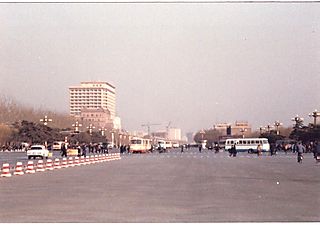
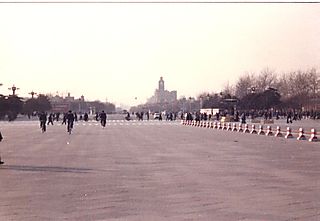
You'll notice, too, that there are virtually no cars. That's the way it was then. Bicycles everywhere; buses and trucks but only a few cars, collectively owned and not often driven. I have a clear memory of driving in from the airport, on our way to Beida, on what is now the Third Ring Road and marveling at its emptiness. A few horse carts plied the pavement that night, and people out for strolls, but hardly a car to be seen.
I could go on about the physical changes but suffice it to say that when I returned to Beijing in 1988, after having lived there for the fall semester 1983, I rented a bike and rode up to the Haidian District, which I had known well, and I got lost. The roads were then being transformed and the large modern buildings were sprouting up so quickly that the low, hutong defined landscape was already being lost. So, let's not even talk about 2008.
What I also remember clearly about my first encounter with China twenty five years ago is the realization that I had to un-learn much of what I thought I knew about China. I was a graduate student in political science, come to do my dissertation research. I knew a good deal about Marxist and Maoist theory and ideology; I knew something of the politics of the Maoist period; and I had some understanding of the opening phase of the post-Mao reform period. What I had much less of a feel for was the cultural and social rhythms of the country. My Mandarin was serviceable but I had not had regular daily contact with Chinese people in their own context.
As I came to experience that contact, connections and relationships of all sorts with various and sundry people, I discovered that the political knowledge I had in my head produced only a fragmentary picture of the complex reality of China. As a political scientist, I framed this mostly in political terms. One day, along about October or so, as I strolled through the Summer Palace, admiring the historic architecture and watching families enjoying the park together, I could not for the life of me envision how the country could have been cast into the turmoil of the Cultural Revolution. The extremism of Mao and his helpers was so contrary to the social behavior I was witnessing all around me that I said to myself: "China is not a socialist country, not socially at least. It is Chinese." From then on I have tried to understand politics and ideology in more culturally particular terms. Yes, of course, on one level the Party does articulate and pursue a socialist ideology but this is understood and experienced by most Chinese people only as it is filtered through the historical and cultural context they inhabit.
I was not thinking then, as I do know, in terms of modern expressions of ancient Chinese thought. But I did encounter an element of cultural continuity. Through one of my classmates I became friends with a family off campus. They were not intellectuals. He was a cook at another unit, who was leaving the security of that job to start out on his own with a new privately owned and operated bike shop. His wife cared for their two year old daughter. The husband/father had four or five brothers who all lived nearby. Indeed, he once said that the family came through the Cultural Revolution without too much suffering because the five brothers stuck together and, by their mere presence, threatened retaliation to anyone who might harm the family. Nobody fooled with a family of five brothers (something my father-in-law, one of ten brothers in a Brooklyn family, could well understand).
In any event, I remember biking around one day with my friend and one of his younger brothers. The elder brother went off for some reason, leaving me alone with the younger brother. I can't recall the particulars of the conversation, but we were discussing some plan he had for his own future. He wanted to do one thing, but his elder brother disagreed. I said, in all my cultural naivety, "why don't you just do it." He looked at me puzzled – why did I not see the obvious? – and said, of course, he could not do it if his brother disagreed "because he is the elder brother."
It registered with me at once. As an American, the status of elder brother just did not carry the weight that it did for this young Chinese man. His personal desires or a rational plan were neither enough to overcome the authority of the status of elder. I made a mental note of yet another facet of Chinese society I had to attend to more carefully.
I will not make too much of all of this. I do not want to suggest a simple, unbroken continuity from past to present. Obviously, that is too simplistic. Rather, I reminisce to keep in mind that the other extreme, the idea of total transformation of the past as modernization unfolds, is also too simplistic. China, or any country, is a jumble of past and present. The past shapes the present but the present also shapes the past: "tradition" is constantly reinvented to serve the needs of the moment and "history" rewritten to produce a "serviceable past." China, twenty five years ago, was emerging from the Maoist period (most everyone wore blue workers shirts or green army shirts) and the past, the pre-socialist past, was still to be found. China today, I suspect, simultaneously allows for a wider assertion of some notion of the ancient past but only insofar as it facilitates the rapidly changing present. Just in terms of physical space, there is less room on Changan Boulevard today for the past to manifest itself through the mountains of modern buildings.

 The Useless Tree
Leave a comment