Wandering artist finds his own way to live
By Xu Jitao (China Daily)
Updated: 2006-09-20 09:00For 11 days beginning September 3, Ye Fu stayed in a cage in a community in
Shanghai’s Pudong.
During that time, he did not talk with anyone, including the visitors that
came to his exhibition. All he could do was sleep and meditate.
Ye completed the task as part of his Urban Survival Experience series. He
took part in two previous projects in Beijing last year.
Some people consider him a madman and think of his projects as rubbish, but
others believe he is an honest artist who only wants to reveal the loneliness of
all human beings.
As a controversial artist and poet, the 28-year-old always attracts a lot of
attention.
Ye was born in 1978 in Linyi of Shandong Province. As with most youngsters
who rebelled against the traditional education system, Ye said that he did not
think he learnt anything from school.
"I think I’m always a pupil. I do not think that I benefited from so-called
education from the schools. When I was alone, I liked to read anything about art
and poetry, and gradually, I found I was deeply attracted by them, he said.
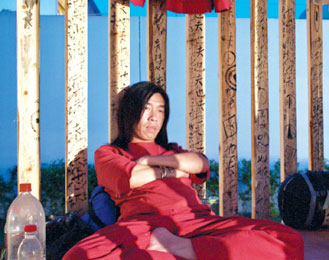
He rejects social conventions, he has given up on "learning," and he wanders "boundless and free" (the title of the first chapter of Chuang Tzu). He has all the right Taoist qualities:
But for Ye, it’s not easy to return to family life. An artist with
avant-garde ideas, he gave up a smooth and steady life and became a wandering
artist and poet.
"It was in 1999 that I became a wanderer,"he said. "I left home and started
to wander around the country."
Ye said he chose to live like a vagrant because he did not like the
lifestyles that his other family members expected him to have.
"All of them hoped that I would get married and have babies, but I did not
like such things. It was not a good environment for me to carry on my artistic
projects in my hometown, so I escaped from that environment,"he said.
After he left his hometown, Ye tried all kinds of jobs in different cities.
"I was a journalist, a salesman, a secretary for the president of an old
university, a model for students at fine arts schools, and a chef. I even sold
slippers in the bazaar and sold pictures I drew on the street. Sometimes I was a
wandering singer," he said.
So, why doesn’t he make the obvious connection to Taoism? Why is the only cultural referent here Borges?
"Last year when I went back to my home, my father told me that he was rather
excited because he had just read all of Jorge Luis Borges’ (an Argentine writer
and poet) works. He even wrote 30 poems and asked me to amend them," he said.
According to Ye, he is still greatly influenced by his father’s ideas. When
Ye meets his father, he will often exchange his ideas with him.
I am tempted to guess that Chuang Tzu and the Tao Te Ching and Lieh Tzu are just so far out of the contemporary popular cultural scene in China these days that even performance artists who are obviously resonating with certain Taoist ideas do not think to make the connections.
Or maybe he is deeply rooted in Taoist thought but the China Daily reporter never picked up on it….

 The Useless Tree
Leave a comment